According to the principles of corporate responsibility, sustainability must be part of the company’s strategy, meaning it must be embedded in the company’s everyday operations. There must be clear goals, and these goals must be closely related to the company’s core business. And because corporate responsibility work is goal-oriented, it must also be measurable. Otherwise, we wouldn’t know what we’ve achieved and what still needs to be done. Whenever companies are asked what they find difficult in sustainability work, the issue of measuring sustainability always comes up. What should be measured—and above all—how should it be measured? What makes a good sustainability indicator?
In general terms, measuring the results of sustainability work should be consistent, transparent, comprehensive, and comparable. Measurement must also be based on planning: what are our goals, what should we measure, how, when, and why? And what should we not measure? It’s also important to remember that while data can be interesting, data that is not used for anything is not worth collecting.
While data can be interesting, data that is not used for anything is not worth collecting.
Before starting to develop indicators, it's a good idea to begin collecting data from where it already exists: the accounting records. This applies when the company has been operating for some time. From the accounting records, we can easily find data on past years' energy consumption, waste and landfill fees, staff training and well-being days, or even the amounts of chemicals used. Even if we can’t fully contextualize all this data, it still provides a clear indication of where the company stands with each issue.
Good indicators are quantitative and therefore clearly measurable, such as kilograms, tons, liters, cubic meters, and kilowatt-hours. In addition, they are normalized so that variations in staff size, production volume, or kilometers driven do not affect them. Once we also link them to time where necessary, we are close to having indicators that are consistent, transparent, comprehensive, and comparable. Year after year.
Let’s look at a few examples.
Heat consumption in kWh/m³/year3is a clear and always comparable indicator. The same applies to electricity consumption in kWh/production volume. In contrast, electricity consumption in kWh/year does not really tell us anything meaningful.
The number of sick leave days per full-time equivalent (FTE) shows the development of sick leave days regardless of fluctuations in the number of employees.
The amount of money spent on repairs per kilometers driven per year already gives a good indication of how much a transport company spends on vehicle repairs. The indicator could be in the form: €/1000 km/year. When drivers are trained in vehicle-preserving driving techniques, it will be easy to determine within two to three years whether there has been a change in repair costs—regardless of the total kilometers driven each year, since that number will vary anyway.
The amount of mixed waste unsuitable for recycling in kg/year indicates not only the volume of waste generated but also the effectiveness—or inefficiency—of sorting. A potential issue with this indicator is that the mixed waste must be weighed, and for example, changes in production may affect the amount of mixed waste. However, if one of the company’s environmental goals is to reduce the amount of mixed waste generated, it is better to measure it—even imperfectly—than to leave the matter entirely unattended.
Customer feedback is especially valuable data for developing a company’s operations. It should definitely be measured. The indicator can be as simple as: the number of negative (or positive) customer feedback messages per € of sales/year.
Measuring corporate responsibility work may feel difficult, but with joint reflection and consideration, good indicators can be found. And if it turns out that the chosen indicators were off, they can and should be developed further. However, any changes to the indicators must be taken into account—at the latest in reporting—when assessing their comparability.
As mentioned earlier, data should not be collected just for the sake of collecting. When indicators are well-defined, they provide us with reliable information about the direction we are heading. That’s why it’s important to carefully analyze the data and share it within the organization with everyone who might benefit from it. This way, the data delivers the greatest possible value.
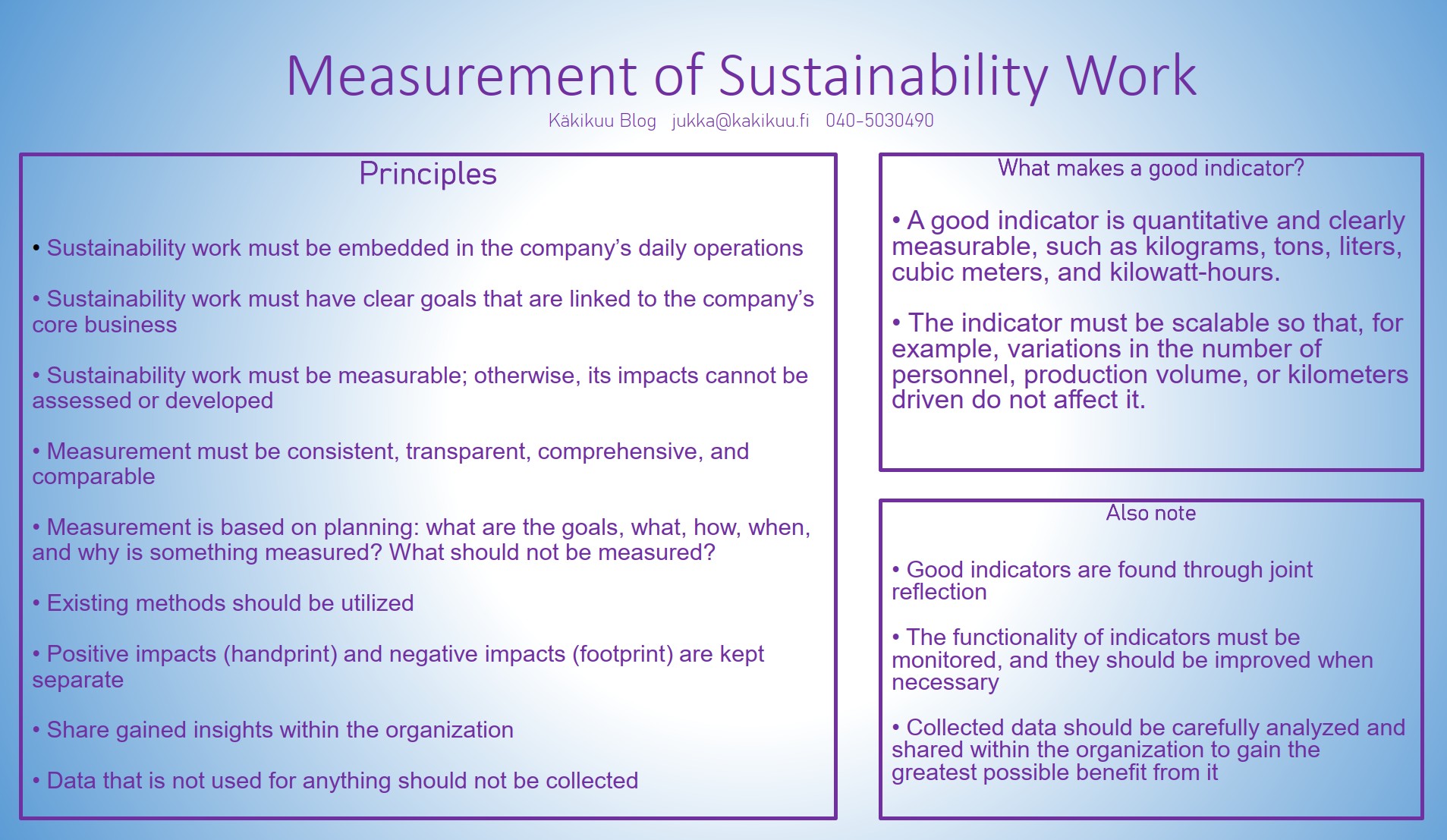
Measurement of Sustainability Work. Key points summarized on a single slide.



 EN
EN  FI
FI