In the context of corporate responsibility, a company’s values, mission, and vision are often discussed. This is understandable, as they form the foundation for the company’s culture and ways of working—including its approach to sustainability.
Each of our personal values forms the foundation for how we act and respond to situations. For one person, family and commitment may be core values, while another may prioritize freedom and independence. For some, honesty and integrity are a part of everyday behavior, while others may be significantly more flexible when it comes to those principles.
In the same way, a company’s values define its culture and are reflected in its daily operations and leadership. And because values guide the actions of every company, it’s worth taking the time to consider what truly matters to us as an organization—and to articulate those as the company’s values. This creates a shared understanding within the company about the foundation we operate on and the direction we’re heading. Such a common ground also helps move forward, especially when difficult decisions need to be made.
It’s worth reflecting on and defining values carefully—and involving as many people as possible in the process. When values are considered and decided together, they encourage the entire staff to act in line with them and in the best interest of the company. Shared values are also easier for everyone to commit to.
It’s also important to realize that every one of us—and every company—has values, whether they’re consciously recognized or not. It’s far better to clearly define those values as guiding principles for the company than to let everyone move in different directions based on vague intuition.
It’s also important to realize that every one of us—and every company—has values, whether they’re consciously recognized or not.
Once we know the foundation we’re operating from, it’s also worth pausing to consider why we do what we do. What is the purpose of our company’s existence—why is it needed? What do we actually achieve through our business operations, and what kind of impacts do we have—especially on our stakeholders, such as customers or subcontractors?
A company’s mission can often be summarized in a simple slogan, like one well-known Finnish food company does: “Good food – better mood.” By making good food, the company contributes to the well-being of all its stakeholders. A mission can also be as straightforward as: “We build high-quality and comfortable homes for people.” That way, everyone in the company knows it’s a construction business and stays focused on that—rather than suddenly starting to sell fishing gear on the side.
Since business is inherently goal-oriented—we’re always aiming for something—it’s useful to pause from time to time and reflect on where we actually want to go. Where do we want to be in, say, three or five years?
This goal—also known as the company’s vision—can absolutely be ambitious, even if it feels somewhat out of reach at the moment. You don’t need to aim for the stars, but bold goals tend to motivate us more and push us to perform better than goals that are too modest or vague.
Our goal could be, for example, to become the largest company in our field within our city or region. In that case, it’s wise to tie the goal to something concrete and measurable, such as revenue. In general, good goals are always clearly measurable and trackable. Statements like “Our pursuit of excellence and innovation makes us better every day” or “We want to create a more vibrant planet for our children” are not visions—they're just vague feel-good slogans. In contrast, visions like “The leading Northern European food company” or “To be the world’s most fascinating lifestyle design brand known for bold patterns” are much clearer—though the latter is harder to measure.
It’s a good idea to update values, mission, and vision from time to time—at least every three years or so—because time passes and things change quickly, as we all know.
All of us—including companies—can have, in addition to our “everyday” values, long-term so-called aspirational values, meaning broader value-based goals we consider important. These might include things like promoting nature conservation, advancing equality between people, or contributing to the national development of our industry. Such values can be reflected in our actions continuously and help guide our decisions—at least whenever it’s possible and feels meaningful to do so.
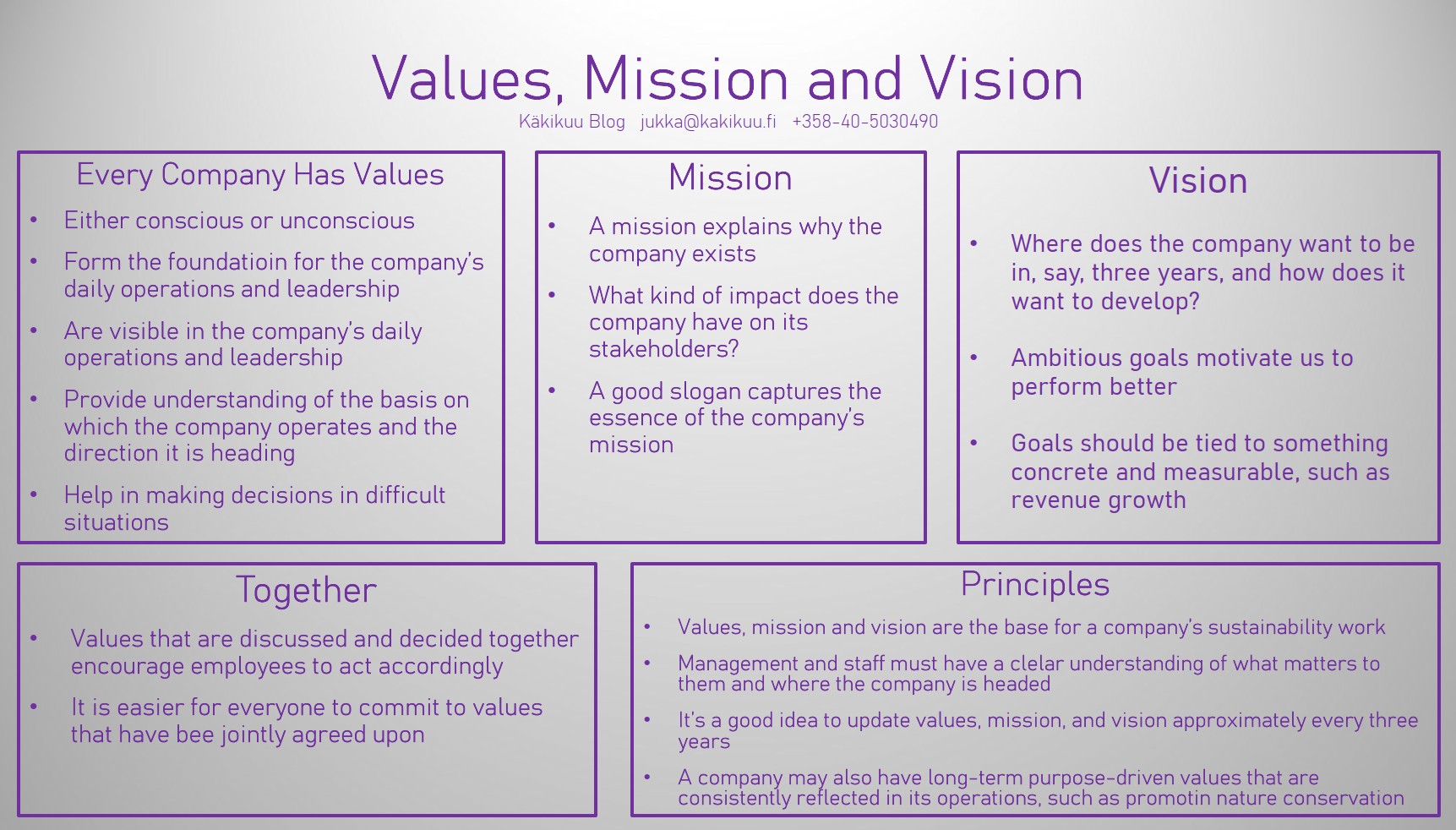
Values, mission and vision. Key points summarized on one slide.



 EN
EN  FI
FI